Reflections on motherhood...

Pages

Showing posts with label Pop psychology. Show all posts

Tuesday, July 8, 2014

My sweetheart the drunk

"It's like hanging out with a drunk person" I said to Captain Boringvoice.  We had just witnessed Milkbaby (now four) push over a large smoothie whilst trying to slide it back across the table to me.  Looking back on it now, even a drunk person knows you don't move a full glass of beer by applying force to the top of the glass.  "Think about it" I went on "- no voice volume control, repeating self, interrupting other people, emotionally volatile, lack of inhibition, argumentative..."

"Hmm" said Captain Boringvoice in agreement, looking at Milkbaby.  "Actually, it's probably more like hanging out with a drunk person who's also on acid", nodding my gaze towards Milkbaby.  At that moment, Milkbaby was using his fingers to create patterns in the maple syrup on his plate, then staring fixedly at each finger before licking it clean and repeating.

A quick google revealed that there's actually more to this comparison than I thought.  In short, the functions that alcohol impairs in the adult brain are quite similar to the functions that are still developing in a preschooler's brain.

It's all about the prefrontal cortex

The prefrontal cortex (the PFC to some, otherwise known as the bulbous bit of your brain immediately behind your forehead) is the smartest part of your brain.  It's the brain's brain.  Its job is to interpret messages from other parts of your brain, and turn that information into a response that reflects both present and future circumstances.  Take crossing the road.  It's your PFC that's saying, "hold it, I hear a car coming, it's not safe to cross now, okay, look the other way, yes, coast is clear, right you can cross now."  See what I mean about present and future circumstances?
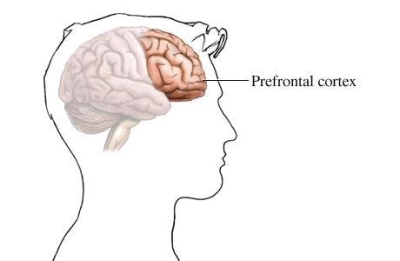
The PFC: ensures you don't cry over toast triangles.

It's also the job of the PFC to exert control over the rest of your brain in social situations to avoid socially unacceptable outcomes.  So the next time you order toast in a cafe, and it's cut in triangles rather than squares, and for some strange reason it really really matters to you and you feel like you're going to cry about it or shout at someone but you manage to hold it together?  That's your PFC going "just hold it together buddy, crying about toast that's cut wrong will create a scene, and we don't want to do that now, do we?"

So let's just do a little tally up.  The main effects of alcohol on your PFC will mean you have:

  • poorer spatial recognition and planning (if we take the crossing the road example again, your drunken PFC is going "how far away is that car?  is it a car?  whatever, just cross the road, I'm pretty sure that moving object isn't going to hit you")
  • poorer recall and decision-making (need I explain?)
  • lowered inhibition (possibly not lowered so much so that you are apt to shout "my wees are coming out!" across a crowded bar, but let's just say your tongue and voicebox volume control will be loosened up somewhat).

And what about preschoolers?

Well...  In humans, the PFC is still developing well into your twenties, and structural changes actually occur during the preschool years.  In short, your threenager is yelling at you for cutting their toast wrong because their PFC hasn't yet grown enough to tell them it's inappropriate to make a scene over such a minor matter.  

The PFC of a preschooler is also still developing its other areas of executive function.  Like decision-making and planning.  This is a pretty common conversation in our house most days right now.

"Honey, do you need to pee?  Because we're going out so it would be a good idea to pee before we leave"
"No."
"Can you just try?"
"NO."
"Please?  It's quite a long car ride and I don't want you to have an accident" [read: the back seat of the car is dubious-smelling enough already without adding another bladder-full of wee to it]
"NO NO NO NO NO!  I DON'T NEED TO GO!"
"Ok, fine, let's not argue about it."

[10 minutes later, on the motorway or some other place quite far from any weeing facilities]

"Mamma?  I need to wee."
"Okay, can you hold on until we find somewhere?"
"No, my wees are coming!!!"
"Okay, just hold on, I'm pulling over."

[As you can see here I'm quite calm and polite about a late wee disclosure, but Jebus it DRIVES. ME. INSANE. and it's usually all I can do not to shout "You've got to be f#@*ing kidding me!!  We JUST talked about this!!"]

Check out the concentration on his
face with all that PFC activity.
Finally, there's recall and decision-making.  Take a skill like covering your mouth when you sneeze.  That involves anticipation, recall, decision-making and a bit of social control for good measure.  It's quite complex when you think about it.  Such a function requires consistent performance from your PFC.  Some adults haven't even mastered this skill, so why is it that beat ourselves up over our child's inability to prevent the spread of his latest lurgy?  Milkbaby's been berated so many times we had this conversation last week:

Milkbaby: "Achoo"
Me: "Cover your mouth"
Milkbaby: "How many times do I have to tell you?!"
Me: "Exactly what I was thinking." 

So, next time you're hanging out with your preschooler, and you're wondering why on earth they're shouting at you when you're right next to them, picking a fight over the colour of their pants, or refusing to use the toilet even though you know you won't be near facilities for the next little while, blame it on an under-developed prefrontal cortex and pretend you're hanging out with a drunk person.

Or even better, a drunk person on acid.  Pretty sure that entitles you to lick maple syrup from your fingers in a crowded cafe.

Tuesday, October 30, 2012

The magic (and science) of kiss betters


I'd always secretly scorned parents who used the old "kiss it better?" with their screaming child.  And believe me, having worked in a children's store throughout my teenage years, I've seen my fair share of this parenting trick.

Recently, I've had outstanding success in deploying the "kiss-better" on Milkbaby.  Our conversations go something like this:

[bump, bang, stubbed toe/banged elbow/head etc]
[inconsolable screaming]
Me: "oh no, what's happened?"
Milkbaby: [more screaming]
Me: "Where does it hurt? Show me"
Milkbaby: [through vicious sobs] "on there" [pointing to hurt body part]
Me: "Want me to kiss it better?"
Milkbaby: [still sobbing] "yea"
Me: [administering a kiss] "there, all better"
Milkbaby: stops sobbing immediately, runs off to play.

It's incredible!  From screaming to silence in a 5 second interaction.

A kiss better also works better if administered
while wearing your best dress and high-heels -
though beware the surreptitious
nose-wipe-on-the-shoulder. 


Turns out there's actually some science behind it - it's the toddler version of the placebo effect.  One study even suggests that the placebo effect may be doubled in children.


However, like any parenting technique, google it and you'll find advice suggesting it's not such a good idea.  Apparently, one should not kiss better:

  • a snake bite
  • a jellyfish sting
  • an open wound.
You would think that in all of the cases above, you'd be better off administering first aid than a smacking great kiss.  Or even thinking about removing your child from the situation causing the jellyfish sting or the snake bite?

You may also want to refrain from administering a kiss better on a bitten tongue.

Thursday, May 24, 2012

Are you "mom enough" for these weird toddler nursing positions?

I know you've all (all 6 of you, that is) been waiting for me to blog about this Time Magazine article:


Let's start by noting that this is a good example of the sensationalist schmaltz Time has been lowered to lately.  But hey, it got headlines and probably sold a few extra copies - so I guess it achieved its goal.

By all accounts (and there are many) the article is not much better.  In case you're wondering, it's about this weird thing that some strange "moms" seem to be doing called "attachment parenting".  And if you're totally green and wondering what "attachment parenting" is, it's a term invented by a man named Dr Sears for a parenting philosophy that suggests that if you are physically and emotionally available to your baby, the baby will form a secure attachment with you.  Well duh!  Except that the term has also become shorthand for more natural or alternative baby-raising-styles, including practices such as bed-sharing, baby-wearing and "extended" breast-feeding.  I hate to use the word "extended" like that - like somehow you've unnaturally managed to "extend" your breast-feeding career contract.  It's just breast-feeding, no matter how long it goes on for.

I digress.  Back to the cover photo.  My first reaction?  Huh, that's an interesting breastfeeding position.  I wonder if I have a milk crate about the right height at home?  I could cook dinner and breast-feed at the same time!

Anyone who has breastfed a milk-addicted toddler has had these thoughts.  Toddlers don't give a rats where you are or what you're doing, they just want the milk RIGHT NOW!  And if you've been clever enough to teach them a cuss-word or two, they might say RIGHT NOW GODDAMMIT!!

We've all seen these lovely diagrams with sleepy, milkdrunk newborns, nursing all quietly.


I thought I'd draw a few of my own that were more relevant to where Milkbaby is at in his "breast-feeding journey" (featuring Jamie Lynn Grumet's new one).

Toddler Nursing Positions:


Give them a go sometime.  But be careful, your toddler might get all attached to you or something.  And not just by your nipple.

Monday, March 7, 2011

Separation anxiety

Every night for the last week I've been having what I'm calling 'separation anxiety' dreams.  I dream, vividly, that Milkbaby is asleep in bed with me (even though we've only ever really been daytime co-nappers), but then as I come to the surface of the dream I can't find him, frantically searching the bed and patting down the duvet.  Last night when I couldn't find him, in some kind of daze, I went to his room to check he was in his cot.  Of course he was there, sleeping happily until I burst in.

The night before I must have been feeling a bit more blasé about not finding him.  I recall conducting my routine duvet-patting, but then instead of getting up, I assumed that he would be in the bed somewhere, and wanting a feed.  So I assumed the normal position for a lying down feed, boob out ready.  My husband, coming to bed a little while later, said, shaking me gently awake, "dear, why are your boobs hanging out?"  I mumbled something about Milkbaby being in bed but not, then did a few more duvet pats before getting out of bed to check that he was in his cot.

Even after seeing him in his cot I still had to do a few duvet pats upon returning to bed, just to be sure.  It's like obsessive-compulsive sleepwalking.

And if I’m not duvet-patting and sleepwalking, I’m dreaming that I’ve left Milkbaby in the car or somewhere else, happily asleep while I run a few errands – but the dreams all go awry when I am prevented from getting back to the car – a giant motorway springs up between me and the parked car, or, even more strangely, a crowded swimming pool and swimming carnival conspire to prevent me from getting back to him.

I am pretty sure that our old friend Sigmund Freud would have something to say about these dreams.  By strange coincidence I am currently reading The White Hotel, by D.M. Thomas, a novel based on a fictional patient of Freud’s – and a veritable cornucopia of weird dream imagery.

Since Freud is no longer around to provide an interpretation of my missing and neglected baby dreams, I’ve consulted Google and come up with the following possible explanations: 
·        Aunty Flo says: To dream of neglecting your baby (or a baby which is neglected) then this dream indicates that you need to pay yourself more attention. On the other hand, this dream can also signify that you need to protect your children much better.
·        The Dream Doctor says: Common dream among young mothers, reflecting literal anxieties about the responsibilities of motherhood. In more experienced mothers dreams of neglected babies may symbolize neglect of relationship with one's partner, (the fruit of the relationship). Also can symbolize neglect of oneself: Dreamer is not caring for one's inner child.
·        Dream Moods says: forgetting about a baby represents an aspect of yourself that you have abandoned or put aside due to life's changing circumstances. The dream may serve as a reminder that it is time for you to pick up that old interest, hobby, or project again. 

This has led me to the conclusion that consulting the internet for interpretations of your dreams is probably not a good idea.  I did find, however, that if a Beanie Baby appears in your dream this suggests “that you are able to adapt to most situations. Consider the animal or the name of the beanie baby. The dream may have an underlying message or a pun.”

I’m thinking that the underlying message might be “you need to get out more and spend less time with your collection of Beanie Babies”.

Tuesday, March 1, 2011

Baby brain - myth or truth?


A typical evening conversation in our house:

Me: "hey I was thinking... this weekend we need to..."
(30 seconds elapse)
DH: "we need to what?"
Me: "what?"
DH: "you were saying we needed to do something this weekend"
Me: "was I?  Umm, nope it's gone, sorry."

Baby brain.  That universal phrase useful for excusing almost all forgetful/vacant behaviour both during and after pregnancy.  Some say myth, some say unfortunate reality.

As demonstrated, I continue to suffer from its common symptoms, namely:

(a)   returning items to places where they're not commonly found (muesli in fridge, yoghurt in the cupboard)

(b)  continually losing my keys
(c)   buying, but forgetting to display, a parking coupon (that was a $40 ticket!)
(d)  not keeping appointments and coffee dates
(e)   repeating the same boring story, to the same people
(f)    saying “did I tell you this already?” (this prevents (e) above)
(g)   using words and phrases like "you know", "um", "that thing over there" instead of common words
(h)  trailing off mid-sentence, with no recollection that I was even saying anything upon prompting
(i)     and saying “what were we talking about again?”


Two recent studies have looked at this so-called phenomenon.  A 2008 review concluded that pregnant women are "significantly impaired on some, but not all, measures of memory" and that these effects are also observed post-partum.  But apparently it's a modest deficit, kind of like comparing 20-year-olds with 60-year-olds.  So baby brain is just one of the little insights we get into what it's like to be old, along with a long list of other ailments that we won't go into here.

Another study, carried out in 2010, noted that the literature on animal-model studies had shown pregnancy and motherhood to have the opposite effect - with rats showing better spatial learning and memory during pregnancy and beyond, and rat mothers performing better than their baby-less counterparts at navigating mazes.  Strangely, no-one's reported seeing rat mothers cursing into their handbags looking for their car keys.


This study found that pregnancy had no effect on cognitive ability, concluding that the "results challenge the view that mothers are anything other than the intellectual peers of their contemporaries."  Phew.  

So perhaps I was this forgetful before.

What were we talking about again?

Related Posts Plugin for WordPress, Blogger...